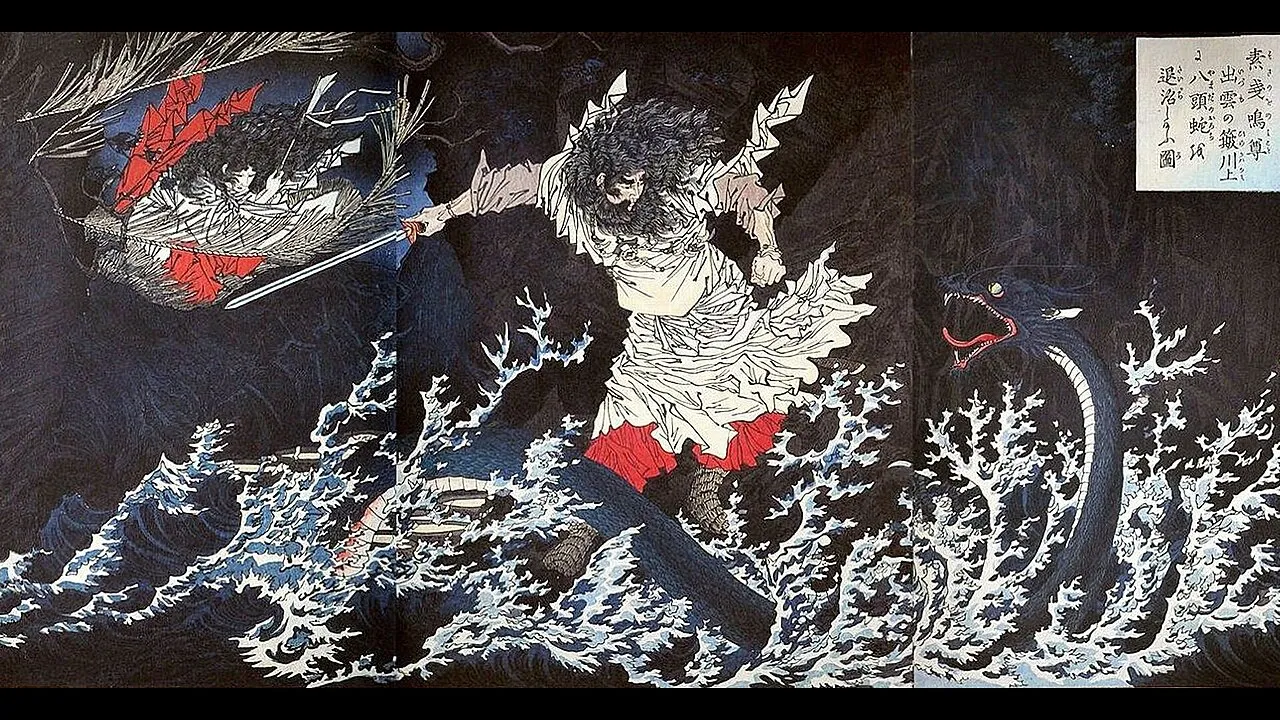
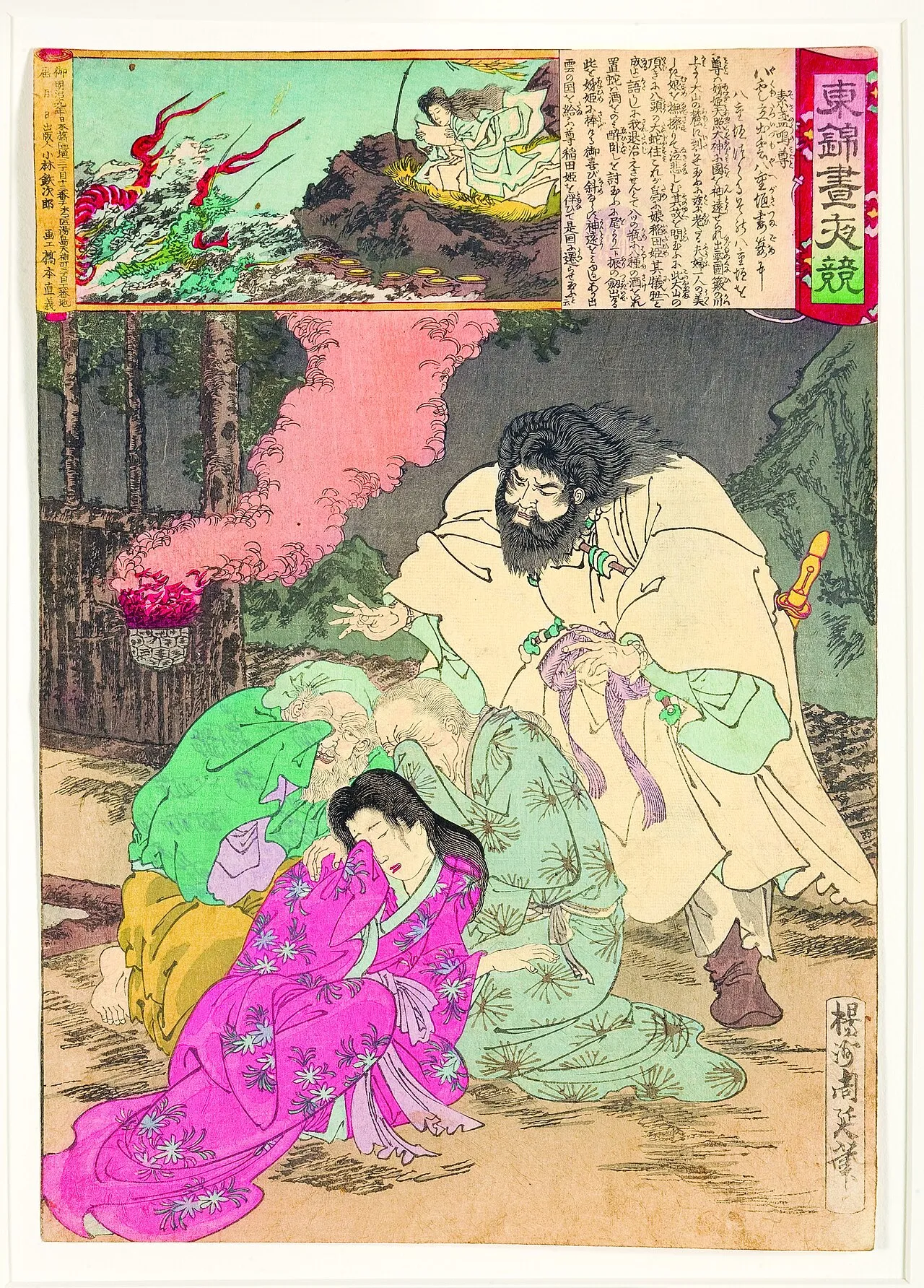

Four scenes from the myth
Born from a purification
The creator god Izanagi returns from the land of the dead and washes himself in a river. Three great deities are born as he cleans his face: Amaterasu, the sun goddess, from his left eye; Tsukuyomi, the moon god, from his right eye; and Susanoo from his nose. Izanagi gives Susanoo the sea to rule, but Susanoo only weeps and asks to go to his dead mother.
Chaos in heaven
Before leaving, Susanoo visits his sister Amaterasu in the heavens and goes on a rampage. He wrecks her rice fields and throws a flayed horse into her weaving hall. Amaterasu hides in a cave and the world goes dark. The gods lure her out, then cut Susanoo’s beard and nails and expel him.
The eight-headed serpent
In Izumo, western Japan, Susanoo meets an old couple crying beside their last daughter, Kushinadahime. A serpent with eight heads and eight tails, Yamata no Orochi, has eaten the other seven. Susanoo turns the girl into a comb and puts it in his hair. He sets out eight vats of strong sake, waits for the serpent to drink itself asleep, and cuts it to pieces. Inside one tail he finds a sword, later called Kusanagi, which is now one of Japan’s three imperial regalia.
A husband and a poet
Susanoo marries Kushinadahime and builds a palace at Suga in Izumo. The Kojiki says he composed a poem there, “Yakumo tatsu…”, which is traditionally counted as the first Japanese waka poem. The troublemaker ends his story as a protector.
From storm god to guardian against disease
Summer in old Kyoto brought epidemics, which people blamed on angry spirits. In 869, when plague spread, 66 halberds were raised at the Shinsen-en garden, one for each province of Japan, to calm them. That ritual is the origin of the Gion Matsuri.
The god honored was Gozu Tennō, the “Ox-Head King”, a fierce deity who could either spread disease or keep it away. For centuries he was identified with Susanoo. When the new Meiji government separated Shinto from Buddhism after 1868, Gion Shrine was renamed Yasaka Shrine and its deity officially became Susanoo alone.
A folk tale explains the protection. A traveling god asked two brothers for a night’s shelter. The rich younger brother refused, and the poor elder brother, Somin Shōrai, took him in. In thanks, the god promised to spare Somin’s descendants from plague. In an early version of the tale, quoted from the lost 8th-century gazetteer of Bingo Province, the god reveals himself as Susanoo. Today, charms reading 蘇民将来子孫也, “I am a descendant of Somin Shōrai”, still hang over doorways in Kyoto.
Festivals
Gion Matsuri
Yasaka Shrine and central KyotoJuly 1–31★ Easy access. Walk from central Kyoto stations. Main parades on Jul 17 and 24.
Glossary
Kami神
A Shinto deity or sacred presence. Kami can be gods from myth, spirits of nature, or deified people.
Mikoshi神輿
A portable shrine. During the festival the kami rides inside while people carry it through the neighborhood.
Otabisho御旅所
The kami's temporary lodging during a festival, often in the busiest part of town.
Goryōe御霊会
A ritual to calm angry spirits believed to cause disaster and disease. The Gion Matsuri began as one.
Kojiki古事記
Japan's oldest surviving book, compiled in 712. It records the myths of the kami.
References
- Kojiki (712). English translation: Basil Hall Chamberlain, 1882.
- Nihon Shoki (720). English translation: W. G. Aston, 1896.
- Yasaka Shrine, official website: deities and festival schedule.
- Kokugakuin University, Encyclopedia of Shinto: “Susanoo”, “Gion shinkō”.
Last checked 2026-10-12.