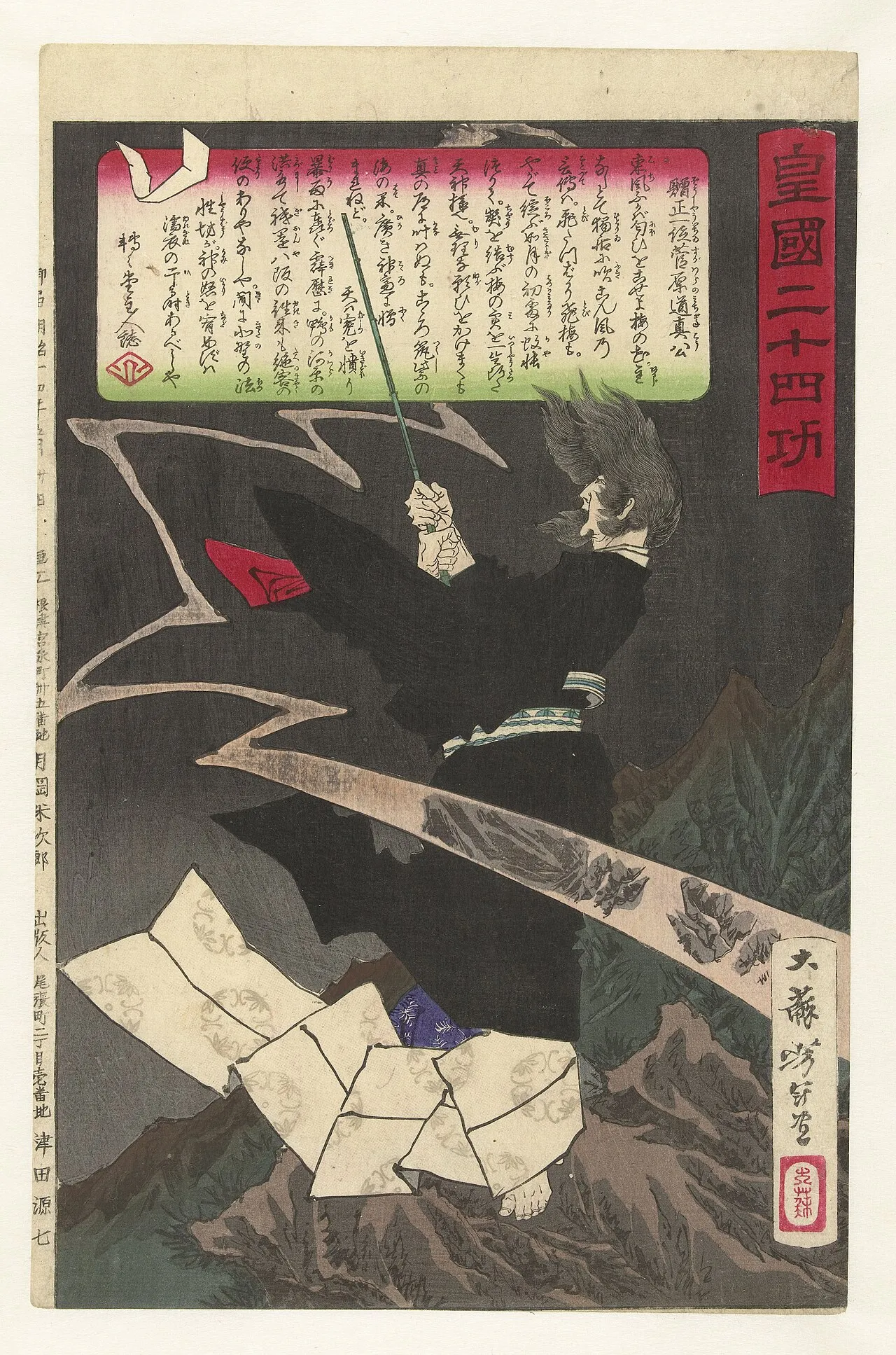
From scholar to kami
A brilliant career
Sugawara no Michizane was born in 845 into a family of scholars. He became one of the finest poets and teachers of his age and rose to become Minister of the Right, one of the highest posts at court.
Exile
His rise made enemies. In 901 rivals in the powerful Fujiwara family accused him of plotting against the emperor, and he was sent to Dazaifu in Kyushu, far from the capital. He died there in 903. Legend says the ox pulling his coffin stopped and would not move, so he was buried on that spot. Dazaifu Tenmangū stands there today.
The angry spirit
After his death, disaster struck the capital. His rivals died one after another, and in 930 lightning hit the imperial palace. People believed Michizane’s angry spirit was taking revenge, and they linked him to thunder. To calm him, the court restored his rank and he was worshipped as a kami. Kitano Tenmangū in Kyoto was founded for him in 947.
God of learning
Over the centuries the feared spirit became a kind and wise one. Because Michizane was a great scholar, Tenjin became the patron of learning. Each winter, students crowd his shrines before entrance exams.
Plums and oxen
Michizane loved plum trees. As he left for exile he wrote a famous poem to the plum in his garden: “When the east wind blows, send me your scent, plum blossoms. Even without your master, do not forget the spring.” Legend says the tree flew to Dazaifu to be with him. Tenmangū shrines are planted with plum trees and bloom in February and March.
The ox is his other symbol. You will find bronze oxen lying in the grounds, polished by visitors who rub the head for wisdom or the part of the ox matching their own aches.
Where you’ll meet him
- Tenjin Matsuri, Osaka (July 24–25): one of Japan’s three great festivals, with a river procession of about 100 boats and fireworks.
- Baikasai, Kitano Tenmangū, Kyoto (February 25): the plum festival on the anniversary of Michizane’s death, with an open-air tea ceremony served by geiko and maiko of Kamishichiken.
- Usokae, Dazaifu Tenmangū (January 7): visitors swap small wooden bullfinch figures in the dark, trading the year’s bad luck for good.
At any Tenmangū, look for the racks of wooden ema plaques covered with students’ wishes to pass their exams.
Festivals
Baikasai Plum Festival
Kitano Tenmangū Shrine, Kamigyō Ward, KyotoFebruary 25★ Easy access. City bus to Kitano Tenmangū-mae, right outside the shrine.
Glossary
Kami神
A Shinto deity or sacred presence. Kami can be gods from myth, spirits of nature, or deified people.
Goryōe御霊会
A ritual to calm angry spirits believed to cause disaster and disease. The Gion Matsuri began as one.
Ema絵馬
A small wooden plaque on which visitors write a wish and hang it at the shrine. Exam wishes fill the racks at Tenmangū shrines.
Omamoriお守り
A small cloth charm sold at shrines and temples for protection, health, safe travel or success. Keep it closed and carry it with you.
References
- Dazaifu Tenmangū, official website: Sugawara no Michizane and annual festivals.
- Kitano Tenmangū, official website: history and Baikasai.
- Osaka Tenmangū, official website: Tenjin Matsuri.
- Kokugakuin University, Encyclopedia of Shinto: “Tenjin shinkō”.
Last checked 2026-10-12.